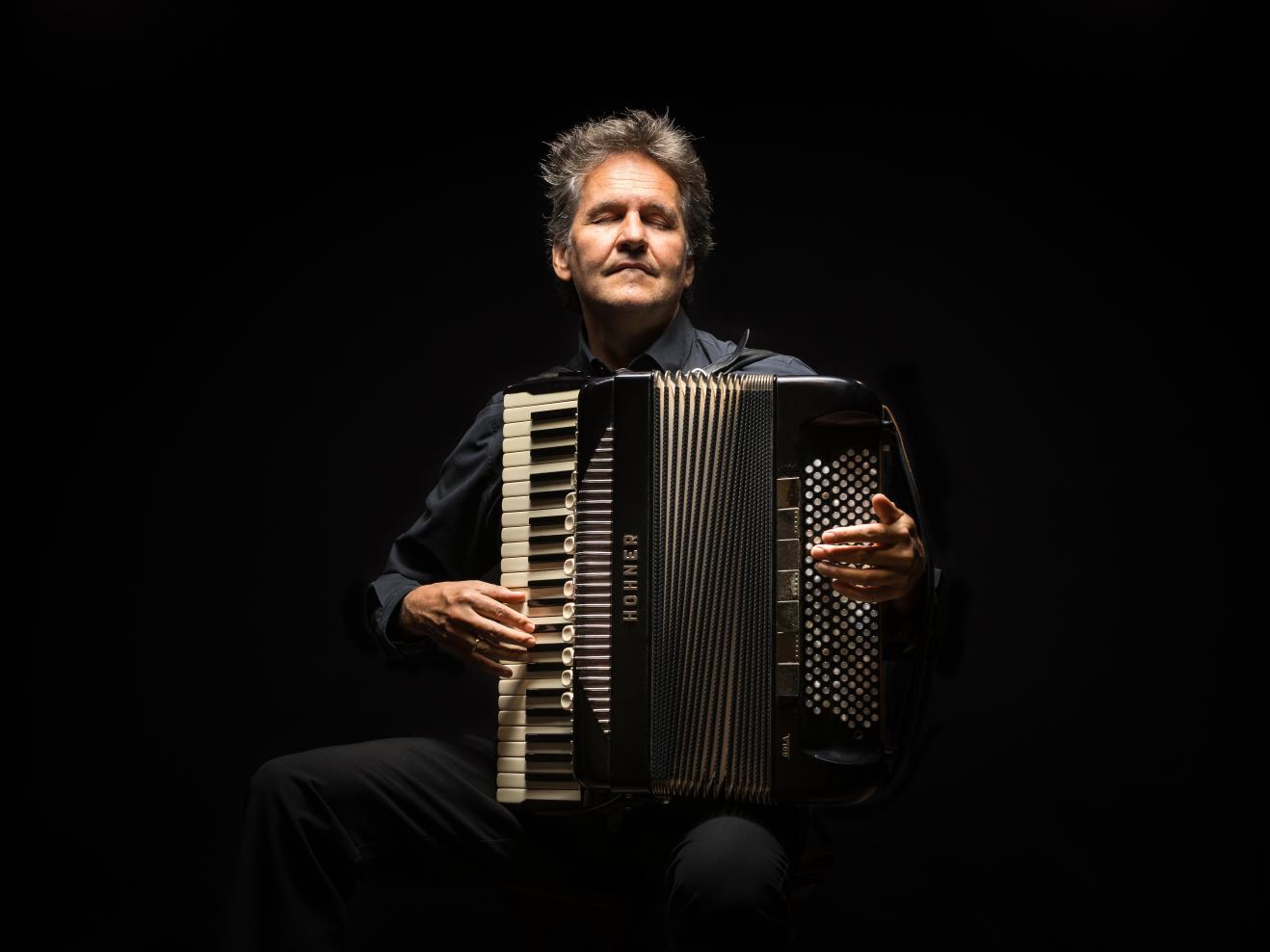
The accordion
The accordion, according to the website that named the instrument of the year, is officially named the instrument of the year in 2026, as the accordion has far more to offer than many suspect: it is a sound body, rhythm machine, orchestral substitute and sometimes even latent comedian in a single rectangular package. With this award, the German state music councils want to show the versatility of the instrument and put an end to the often ridiculed "squeeze image". Originally, Cyrill Demian patented the first accordion in Vienna in 1829 - and thus gave the instrument an incredibly lively future. The name is not derived from a strange German neologism, but from "chord", because the first models sounded entire chords when the key was pressed. Source
Source Questions to Andreas Nebl, lecturer for accordion about his newly chosen musical instrument:
Have you ever wondered what an accordion would sound like if, instead of air, water or another liquid flowed through the bellows? Do you think that could work, and what would it probably sound like?
(Laughs!) That's quite an imaginative question right from the start! To answer it somewhat objectively: yes, it would sound completely different, because the tone of the accordion is produced by freely vibrating metal reeds, which can only be set into motion by air. As soon as liquid, instead of air, flowed through the bellows, the instrument would remain tonally silent. Of course, I don't want to rule out anything technologically for the future—but so far, such a process would only lead to a major repair.
What would you say to people who have never heard an accordion live, to help them open up to the sound of this instrument?
I invite everyone to one of my concerts to experience this instrument through listening. The accordion is certainly unique in its sound and dynamic movement. There is quite a lot of exciting solo repertoire by now, but in my view, it is most interesting in chamber music. Many pieces from other times should also be explored with this young instrument, presenting them in a new guise purely from the principle of musical education. The accordion is not a style—possibly suggested by certain sectors of the public—but an instrument whose specific timbres arise from registers and a bellows that, ideally, can be 'attached' to the breath while playing. The keys and buttons of the accordion can be lowered and raised through nuanced articulation. They open and close the spaces that allow the air provided by the bellows to flow to the sound material. Some tonal cross-connections. I don't find some of the tonal connections to the organ and clarinet unreasonable at all.
What fascinates you most about the accordion, something that you think other instruments cannot achieve?
The accordion can dynamically influence sustained sounds and, through the means of articulation, make them simultaneously transparent. What is fascinating is that, unlike any other instrument, it lies very close to the human body over a large area. This creates a whole-body interaction with the air in the bellows, which is so crucial for the sound. On the one hand, the bellows are initially operated with the left-hand side of the instrument via a strap. However, as soon as the body moves freely, the bellows take on a different angle, and the tone is immediately affected. That is why it is indeed the entire human body that shapes the accordion’s sound. The cyclical or anti-cyclical interplay of the two lungs – the human one and the mechanical one in the accordion bellows – during playing remains, in my view, enormously fascinating.
You regularly play in international ensembles and at festivals—has there been a musical experience with the accordion that particularly surprised you or changed your perception of sound and audience?
For many years, I have been organizing concerts in Japan together with the Japanese artist Naoko Takeuchi. In 2014, at a midday concert in Mie Prefecture, I performed before approximately 2,000 people, including the piece "Melodia" by the Japanese composer Toshio Hosokawa. It was written for the accordion in 1979, but it is also heavily influenced by the traditional, spiritual atmosphere of gagaku music at the Japanese court since the early 9th century, in which the instrument "sho" (the predecessor of the modern accordion) plays a central role. During the roughly twelve minutes of the performance in this large hall, I experienced an almost incomprehensible, focused silence, a way of listening that I have never experienced before or since. In our part of the world, this piece is on the one hand classified as "New Music." However, there it became profoundly clear to me that, on the contrary, with it I was also engaging with THEIR music, which has long been embedded in the collective consciousness over many generations. A strong feeling of humility overtook me. By the way, I will also perform this piece at the concert with my class on Sunday, June 21, 2026, at HMDK.